
Reply time meaning: pace is not a caring score
See how burst-to-reply timing, the median, and long waits describe a chat without explaining the person.
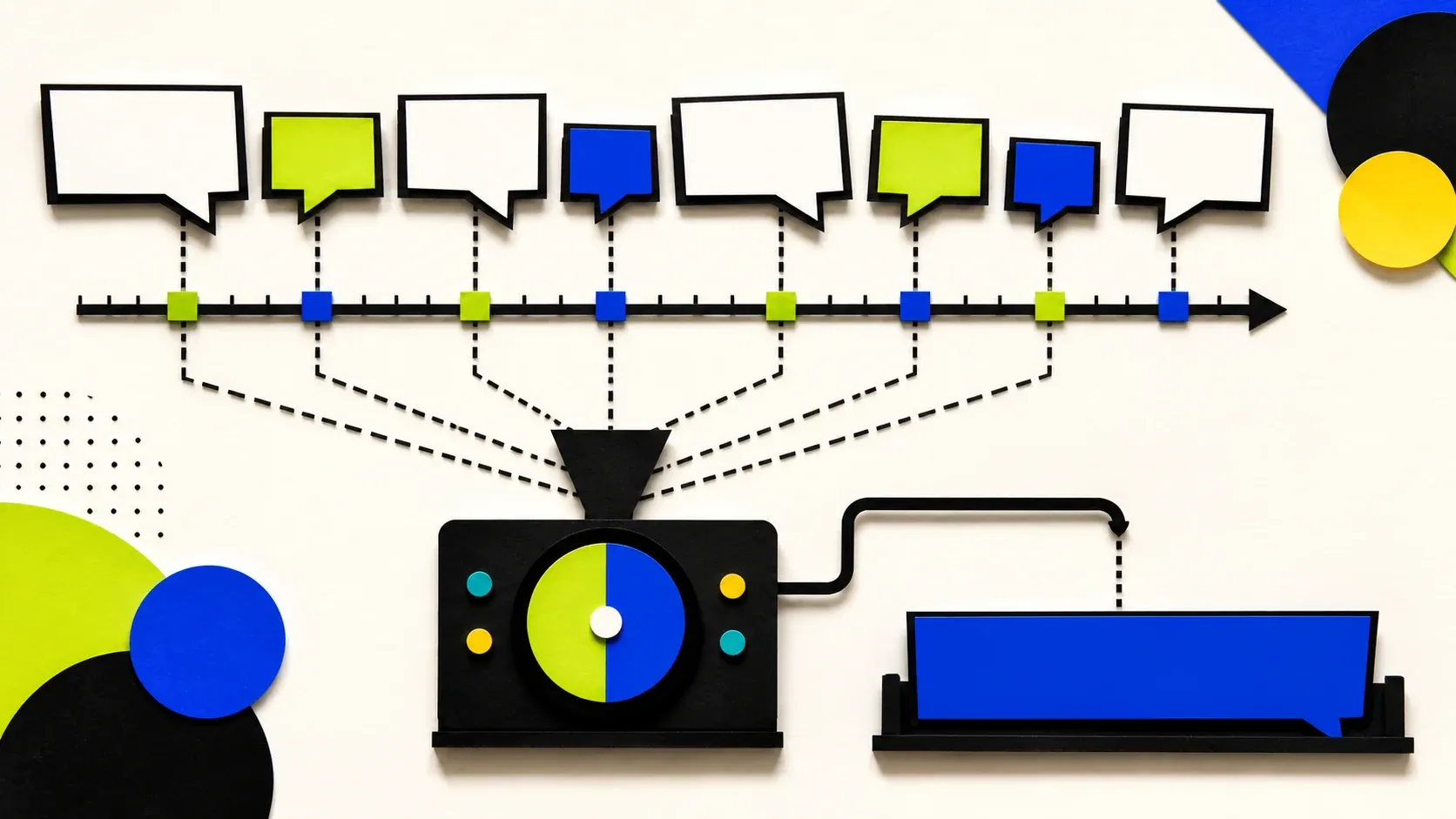
1. Reply time measures a gap between bursts
In Tellune, reply time shows how long one person’s message burst waited for the other person’s next burst. Tellune reports the median separately for each person. The result describes timing; it cannot measure caring, interest, availability, avoidance, or the reason for a gap.
A burst is a run of consecutive messages from one sender with less than two minutes between them. The clock starts when that burst ends and stops when the other person’s next burst begins. The full chat-reading method places this timing measure beside the other observable indicators.
2. The median uses replies under 24 hours
Tellune sorts each person’s qualifying reply intervals and uses the middle value, or the midpoint of the two middle values when the sample count is even. Each person needs at least four timed replies. If either side has fewer, reply pace is unavailable.
| Sequence | Reply-pace treatment | Reason in the calculation |
|---|---|---|
| Several same-sender lines less than two minutes apart | One burst | Quick lines share one burst end |
| The other person starts a burst in under 24 hours | Included as a reply interval | It falls inside the reply window |
| The next opposite-sender burst is at or beyond 24 hours | Excluded from reply pace | It is handled as a long wait |
| Fewer than four timed replies from either person | Reply pace unavailable | The minimum is not met on both sides |
The median is not a summary of every silence in the export. Intervals at or beyond 24 hours do not enter it, and the result keeps each person’s timed replies separate. Check the displayed sample size before treating the headline as a broad pattern.
3. Long waits are counted outside reply pace
Tellune records a Long waits event when a burst waits at least 24 hours for the other person’s reply. That indicator needs at least 20 timestamped messages. The final burst in an export is marked as still open rather than judged as a completed long wait.
This separation matters when a conversation contains several turn-taking sequences. Different bursts can end with a quick reply, another same-sender follow-up, or a long wait. The double-texting guide covers the follow-up sequence; reply pace and long waits keep their own definitions.
4. Context belongs in questions, not the number
Use the report to check the parts the chat can answer:
- Are there at least four timed replies from each person?
- Are you looking at the median reply pace or the separate long-wait count?
- Does the imported date range match the period you meant to inspect?
- Is the last message still open rather than a judged long wait?
The reason for a delay is outside those fields. If that reason matters, it requires information beyond the timing calculation. Do not fill the gap with a claim about attention, interest, avoidance, or personal worth.
5. Compare timing later without assigning cause
A rematch can compare reply pace when both reports use the same indicator version, both values are available, and their units match. That gives you a bounded before-and-after measurement of the same stored field.
A changed median does not prove what produced it. The guide to measuring change over time keeps that distinction visible: the reports can show a delta, while cause remains unresolved.